


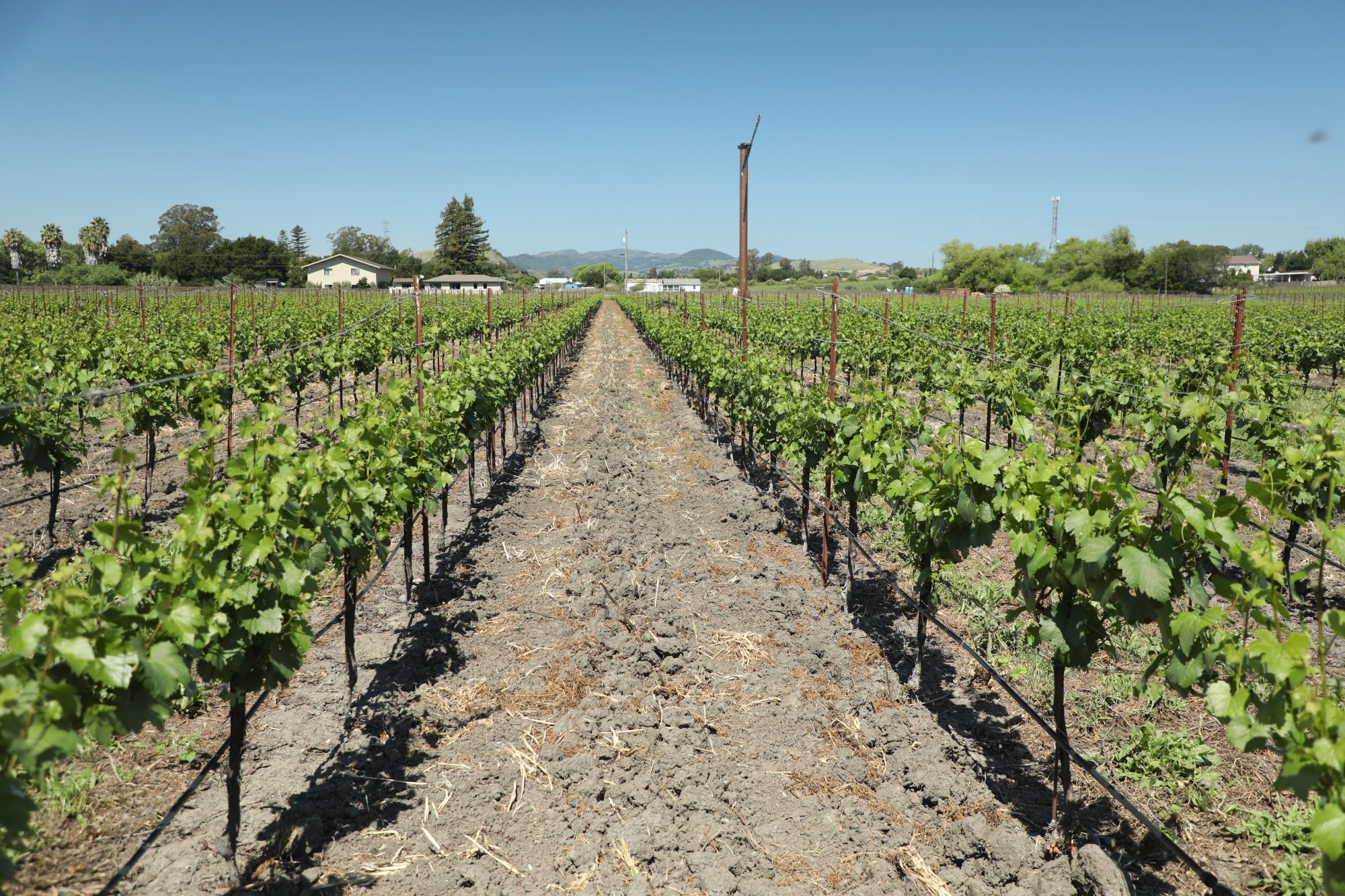
 The Thomson family history in Napa Valley dates back to 1938, when grower and proprietor of Thomson Vineyard, Jennifer Thomson’s great-grandmother, Jenny Ophelia Barnum Thomson, and her husband, Matthew Alexander Thomson (Sr.) relocated from Oklahoma during the Dust Bowl. Matthew and his two brothers helped build the Oklahoma City airport before moving west to establish a branch of Thomson, Thomson & Thomson (heavy excavation company) based at the ranch.
Jenny acquired the 30-acre property in 1938 on the steps of the Napa County courthouse from inheritance after her parents passed away in a car accident. Although she initially purchased it in her own name, ownership was later transferred in the deeds to her husband and father-in-law. An aerial photo the family has from the 1920s shows that about 30 acres of the property were already planted to orchards.
At that time, the ranch functioned as a true agricultural hub. It included a two-story drying shed used for apricots, pears, apples, and prunes, along with surrounding sulfur houses, a blacksmith shop, farmworker housing, and corrals for local stockyards. A house on the property, still standing today, once sat along a stagecoach route. The ranch supported the surrounding community and was primarily planted to pears and prunes.
Jenny and Matthew had a son, Matthew Alexander Thomson Jr.,; he and his wife had five children, George Thomson, the eldest, born in 1949 and father of current owner, Jennifer Thomson. The family became the last contract pear growers for California Canners and Growers, which had a major partnership with Del Monte. In the 1960s, Carneros was still heavily planted to pears and prunes, but by the late 1950s and early 1960s the family began experimenting with alternative crops. They ultimately planted a Martini clone of Pinot Noir, which remained in the ground until 2018 in 10′ x 6′ spacing. Jennifer wanted to keep this historic planting, but without contracts and with wider spacing limiting tonnage, it was no longer economically viable and was removed in 2018.
Early on, the vineyard evolved to roughly 40% Pinot Noir, primarily Martini clone, and 60% Chardonnay based on UC Davis selections, along with additional experimental clones to evaluate site suitability. Water, however, was always the defining challenge. As early as 1941, the family studied water flow on the property, with the water challenges of the Dust Bowl still very much on their minds; they quickly recognized Carneros was water-deficient. While there was enough for household use, agricultural water was limited. In 1950 the family applied for a federal soil conservation grant and secured the right to build a dam on Carneros Creek bordering one side of their property.
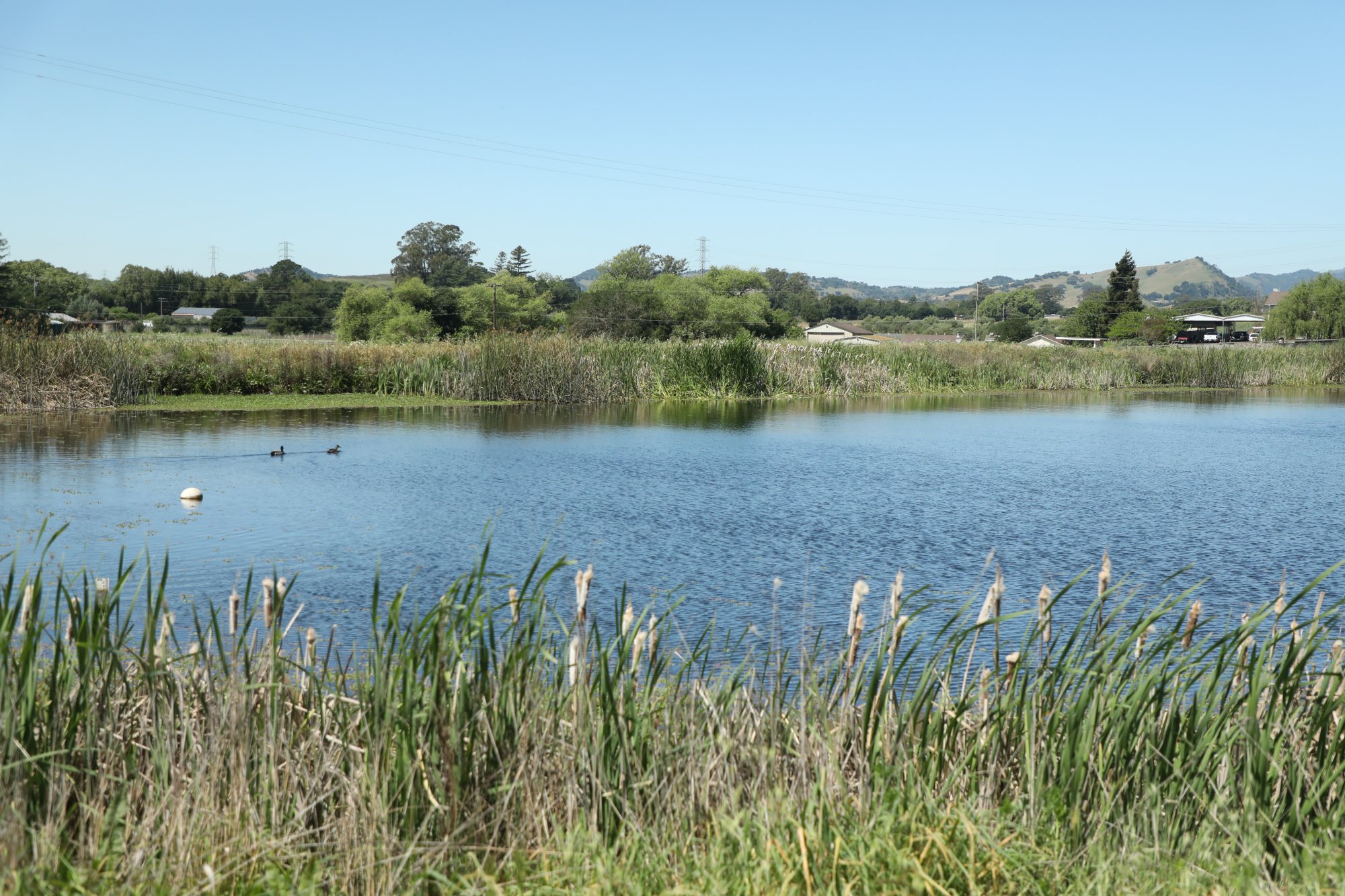
Four years later they built a 31 acre-foot reservoir in conjunction with the Army Corps of Engineers. Using their own heavy equipment, including a D8 tractor, they constructed the reservoir, which captures runoff from a 144-acre watershed feeding into Carneros Creek. This project ensured a sustainable agricultural water supply and became foundational to the ranch’s long-term viability. Today Carneros is dotted with small reservoirs, collecting water for agricultural purposes; according to Thomson, theirs is the oldest in the region.
Jennifer’s grandfather, Matthew Jr., was also an engineer, working with California Vegetable Concentrates in King City, CA and helping develop one of the earliest mechanical onion harvesters. The family’s ethos has always been rooted in hard work and practical problem-solving.
Pears were graded using canning rings into size categories, and achieving those sizes required reliable irrigation. The family developed a local reputation for understanding water management and irrigation practices. George worked for Carneros grower and art collector, Rene di Rosa from high school through his time at Sonoma State, during a period when many in the industry believed Carneros could never produce great grapes due to poor soils, challenging weather, and limited water.
The family continued working closely with government agencies to secure water resources. Matthew Jr. became a founding member of the Los Carneros Water District and advocated for the reuse of reclaimed wastewater, arguing that it should be directed to farmers rather than discharged into creeks. With some of the oldest water rights in the region, the family retained the ability to pump and store water in their own reservoir. For decades, he would hand write a note on the bottom of his annual water right reporting for his property, the following, “Los Carneros water district is working to bring reclaimed water to the region”.
That vision took shape over many years, with efforts from the 1950s through 2012 to build a pipeline from the Napa Sanitation District to Carneros. Jennifer returned to Napa in 2008 after working in San Francisco, where she had been LEED-certifying buildings. She has been deeply involved in advancing water access to the region, drawing on a legacy that her grandfather had documented for decades. By 2011, Jennifer was directly involved, championing a referendum among 111 landowners to self-tax and fund the project. Achieving the required 75% approval, they committed to building an approximately 10-mile pipeline, including tunneling under the Napa River, to bring reclaimed water into the region.
 Between 2008 and 2011, during a particularly difficult financial period, Jennifer helped sell 35 tons of grapes through Twitter direct messages, capitalizing on strong search visibility for the keywords, ‘Carneros Chardonnay’. At the same time, her grandfather considered selling the ranch. Jennifer stepped in to facilitate family communication and ultimately committed to running the property herself. In December 2011, ownership was placed in her name, with full trust from the family, despite her father warning that it was the worst possible time to become a wine grape farmer.
Previously, the family vineyard operations were still run hands-on by her father and uncle, who managed their own crews of up to 40 people in the 1980s and 1990s. Rather than launching a label, she focused on selling grapes, leveraging the family’s heritage, clonal knowledge, and her own hands-on capabilities and found a balance between the old ways of doing things with new ideas and innovations. She successfully sold to respected buyers and negotiated contracts, demonstrating both business acumen and confidence in the vineyard.
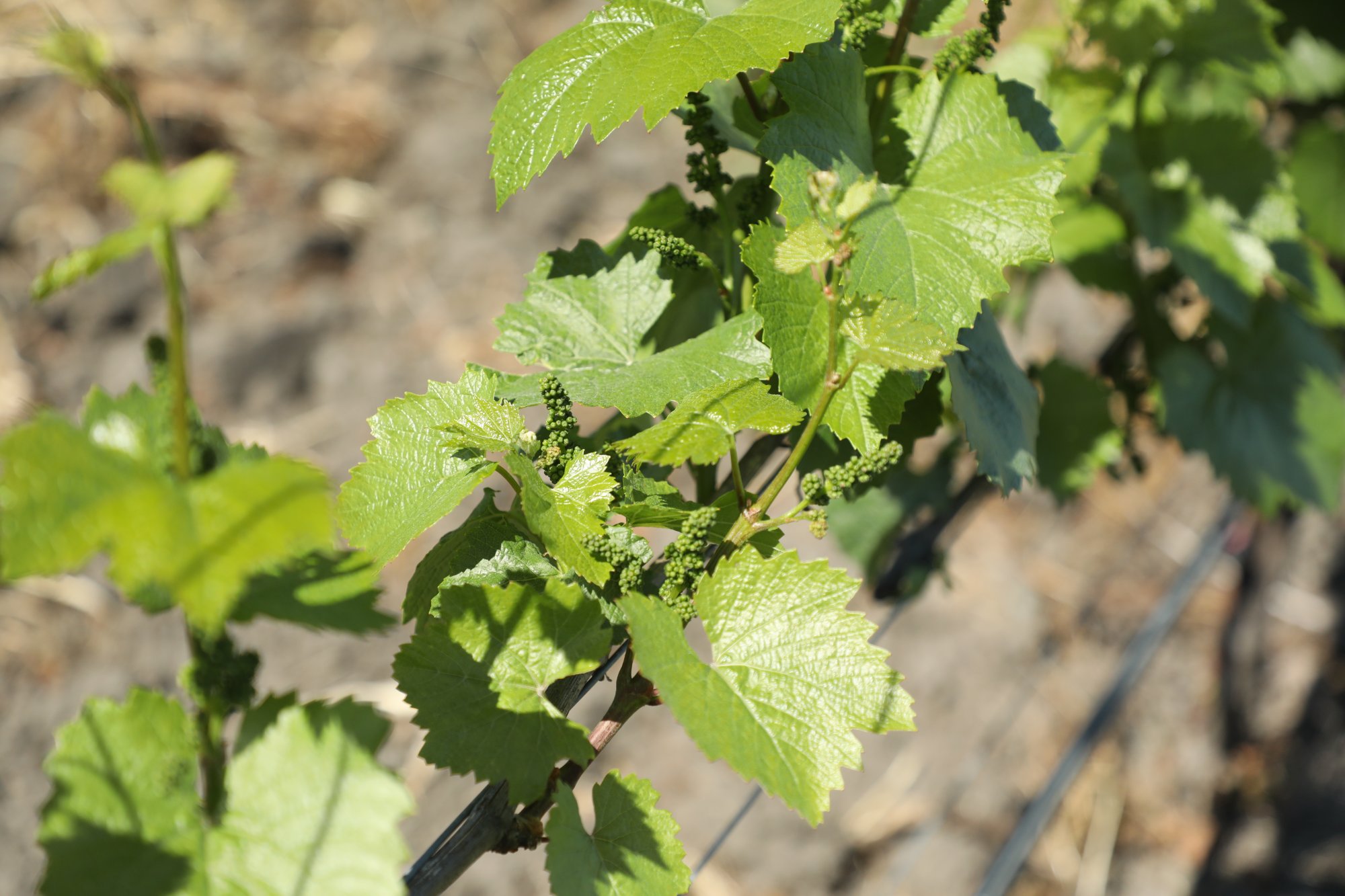
And making farming decisions including types of trellising, i.e., implementing a VSP quad cane system with dual fruiting wires and using JR-Clips, a versatile alternative to traditional cross arms. She also embraced mechanization to improve efficiency such as machine harvesting, leafing and mechanically planting all seven acres of Pinot Blanc in 2020 (Napa Valley’s largest grower of this variety). There is no substitute for generational knowledge of the family property including a deep understanding of the site and the unique challenges of Carneros, i.e., weather variability, mildew pressure, and disease risk.
A key part of her vision has been returning the ranch to its sparkling wine roots, working with producers such as Mumm, Paula Kornell and Phifer Pavitt. At Thomson Ranch, the first under her supervision in 2011 was a true trial by fire. The land was littered with decades of scrap metal, so she removed 17 bins of debris herself, using the proceeds to help fund the planting of Block 9.
She became particularly interested in Italian Chardonnay, arranged by Sonoma County based grapevine nursery, Novavine, including clones VCR 108 and VCR 10, which stood out in tastings for their distinct character. She chose these over more common selections like Clone 4, trusting her instincts rather than following broader industry trends. In 2015, she also purchased a seven-acre property on Withers Road, known as Livewire Ranch, which had never been planted; today it is planted entirely to Pinot Noir.
Thomson Ranch benefits from long hang times and strong acid retention, especially in the blocks closest to Carneros Creek where temperatures can be up to 10 degrees cooler than the front of the property due to wind patterns and a slightly lower elevation. Today, the ranch has returned to a variety balance similar to the 1950s, with roughly 40% Pinot Noir and 60% white varieties, including Chardonnay and Pinot Blanc but also a small section grafted over to Riesling.
Over the past decade, she has replanted extensively, often five acres at a time, funding everything through cash flow while upgrading equipment and doing as much work herself as possible to control costs.
In 2026 after 88 years as a grower, Thomson Vineyard produced their own sparkling wine, bottled under their own brand. This is a sparkling Riesling and was produced by Thomson Vineyard at Gloria Ferrer in Sonoma County.
Through all of this, Jennifer has maintained a clear philosophy: trust your instincts, rely on the depth of family knowledge, and resist doing something simply because others are doing it – i.e. find something that is differentiating of value.
Leave a Reply