



 Ampleur Cellars was founded in 2023 by winemaker Morgan Maureze and Andrew Wesson. Morgan was born in France to a wine-making family and is where he only spent several years of his childhood. He moved with his family to Napa Valley in 1985 where his father Jean Marie Maureze made wine at Beaucanon Estate and later became the General Manager of Dominus Winery. Growing up immersed in both the French and the American wine world, perhaps it was a natural inclination to follow his family’s wine pursuits. Morgan began working in wine in Napa Valley when he turned 16.
He earned his degree in Viticulture and Enology from UC Davis and then moved to France to continue his education through the University of Bordeaux working at famed wineries such as Petrus and ultimately completing his master’s thesis at the storied Domaine de la Romanee Conti where he interned for six months. Returning to Napa Valley he joined winemaker Andy Erickson’s team – assisting him at a number of Napa’s most premium properties including Screaming Eagle and Dalla Valle, among others. Morgan spent 9 years with Andy’s team before leaving to focus on winemaking at Marciano Estate and Immix Wines. He left Marciano Estate in 2023 to focus on consulting and also building several brands including Ampleur Cellars and making a kosher sparkling wine.
Andrew became interested in wine during college. He studied at the University of Irvine with the intention of pursuing a career screen writing after he graduated. His roommate at the time was George Blanckensee, now Estate Director for Chateau Montelena. During college George was working for a hotel and also worked part time as a wine buyer. Andrew remembers George had a subscription to Wine Spectator; he would read the magazines, starting to build an interest in wine.
While still in college in 1991, Andrew took a trip to Napa Valley; he stayed with the Solari family, the owners of Larkmead Winery. He remembers visiting Chateau Montelena, his second ever winery in Napa Valley and meeting Bo Barrett. But he primarily recalls the evening following a dinner at Tra Vigne Restaurant in St. Helena with the Solari family; he returned to their house located among ancient Tokai Friulano vines. He took a bottle of wine, walked around among the old vines and looked at the stars; this was a unique experience for a urban southern California kid growing up in the 1980s, a period when Los Angeles experienced in particular horrific air pollution. He told himself then, “I have to figure out how to enjoy this type of lifestyle”.
Six months after his first visit to Château Montelena, the hotel where George worked hosted a wine dinner featuring Bo Barrett. After the event, Bo casually suggested something like, “Do you want to go out for a beer?” Andrew recalls being struck by the fact that such a prominent figure in the wine world would want to spend time with people he barely knew. George later moved to San Francisco, where he managed a collective of several wineries, including Château Montelena. Years later, Andrew’s son worked at Montelena as a teenager.
Andrew’s career has been focused on wine sales. Soon after gradating he took a position with a distributor as a sales rep, later transitioned into management and into senior management. His first job at a winery in Napa Valley was as a National Sales Manager for Shafer Vineyards in 2008.
Andrew is the founder of Vinovative Management, a contracted services company that provides a broad range of sales support for wineries, including national distribution. His client roster includes Carte Blanche, Gamble Estates, and Marciano Estate. The idea for the company emerged from a conversation with Bo Barrett, during which Andrew shared his interest in starting his own business, though he had not yet worked out the details. Bo pointed to his wife Heidi’s consulting work with multiple clients and suggested that Andrew could build a similar model—not focused on winemaking, but on helping smaller wineries manage and grow their sales. Andrew’s earliest clients included Dana Estate and TOR.
Both Andrew and Morgan met at Marciano Estate where Andrew was brought on to oversee their national sales efforts. Morgan left Marciano Estate in 2023 and took the winemaking position at Seven Apart. And this change was advantageous because Seven Apart offers space for custom crush and is where the Ampleur wines are produced.
The name Ampleur in French refers to size, magnitude or scope. The partners wanted a French name to highlight Morgan’s heritage. And they cleverly chose a name that alphabetically shows up on the top of wine lists. A new wine brand is rarely without challenges. They discovered that the name ‘ampleur’ was already trademarked and listed in the Doctrine of foreign equivalents, a U.S. trademark law principle that requires foreign words to be translated into English to determine if they are confusingly similar to existing English trademarks.
Andrew researched the ownership of the trademark further and was able to trace it to a couple living in Marin County. He called them, and they discussed the significance of the word. She explained that they were no longer using the name and mentioned the doctrine of foreign affairs. Andrew was surprised by her familiarity with the topic, at which point she revealed that she was a lawyer. She initially offered to sell him the name, but Andrew countered with the idea of trading a case of their first bottling in exchange for the rights to use Ampleur as the wine’s brand name. Fortunately, she agreed.
Morgan and Andrew’s partnership is complementary; Morgan focuses on vineyard sources and winemaking while Andrew’s skill set is on wine sales, supported by a well established network of distributors, national sales reps and other sales channels. Even before releasing any of the Ampleur wine, Andrew began creating a buzz about this label to distributors and others he knows buying wine. New York was the first recipient state in terms of distribution with others following including Texas, Virginia, Illinois, Arizona and California. They launched their brand at Premiere Napa Valley in 2025.
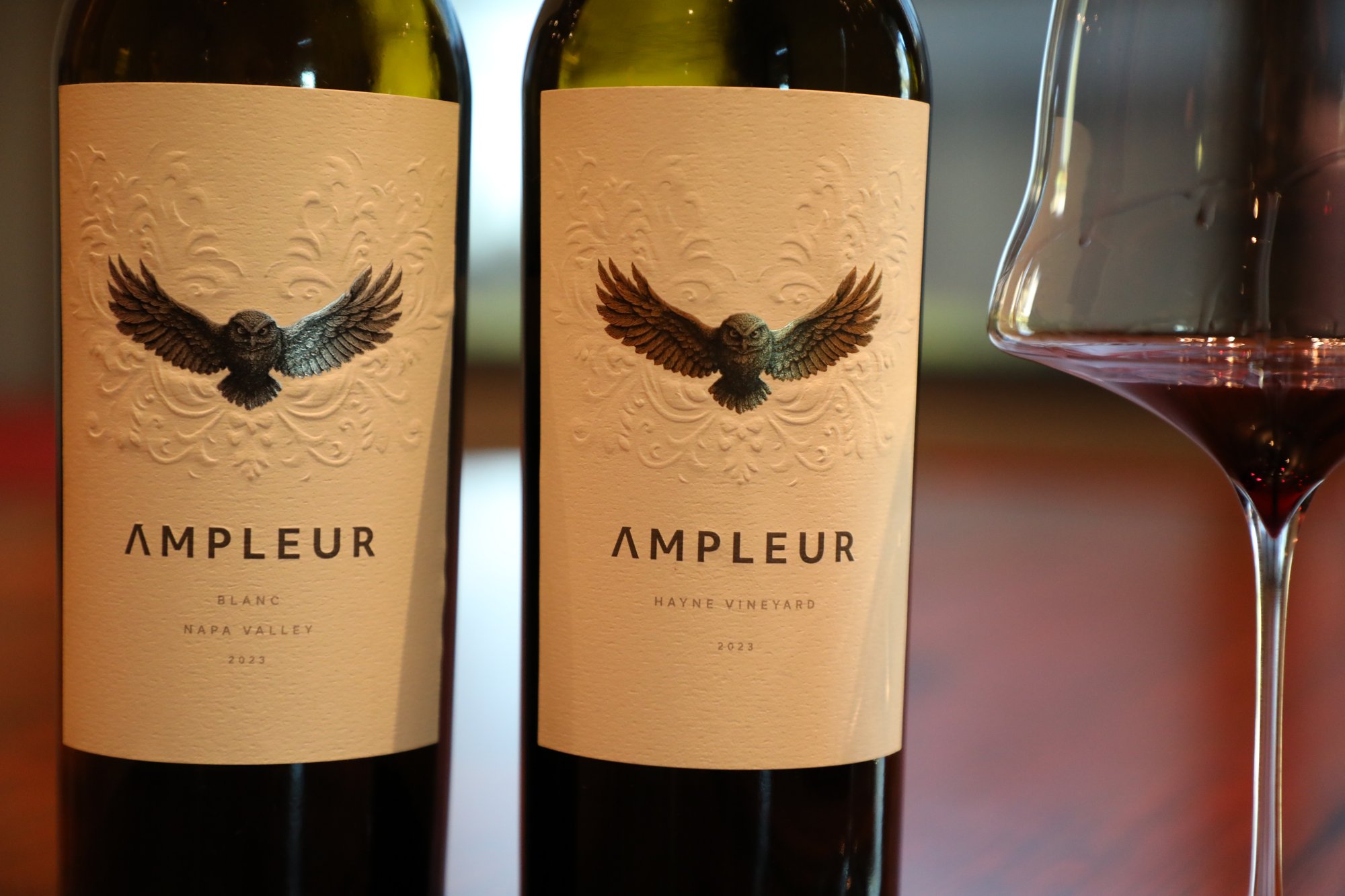
The inspiration for the image was the result of a trip Andrew took to to Greece. While in Athens, he visited the Parthenon and was intrigued by a 7,000 year old statue of an owl, an artifact associated with the Theatre of Dionysus. Ancient owls represents wisdom in Greek heritage. He began to research how to use an image of this statue, but soon discovered objects at the Parthenon are already copyrighted.
So Morgan contacted his brother Jerome, a graphic designer; he took the idea of both an owl and ampleur and created a label depicting an owl flying through mist using a color scheme of gold for red wines and silver for white wines. A UPC code on the back of every bottle provides additional details about each of the wines. And securing their label approval took several months rather than a week or two due to the government shutdown in 2025.
Select Wines
Blanc
 The 2023 Ampleur Blanc Napa Valley is made from 100% musqué clone Sauvignon Blanc and shows a medium-gold hue in the glass. The highly attractive, distinctive bouquet is both fruit-driven and floral, offering aromas of white jasmine, honeysuckle, citrus blossom, and white peach, along with herbal—but not green—notes of lemon verbena and lemongrass. As the wine evolves, a subtle layer of vanilla emerges. Bright, balanced, and vivacious, its acidity lifts the supple, satiny texture beautifully. The palate reveals flavors of golden kiwi, passion fruit, golden apple, mandarin orange, white nectarine, Babcock peach, lemon juice, and guava, followed by a light herbal accent of thyme on the finish. The wine concludes with brightness, energy, and impressive persistence—one of our favorite descriptors, especially when applied to the finish of a white wine. The listed ABV is 14.5%.
Morgan ferments the wine cold and slow, primarily using indigenous yeasts if possible, but may inoculate if needed. When fermentation starts, he lets the head space increase and doesn’t top until November or December, an influence he attributes to his time working with winemaker John Konsgaard. With Chardonnay in particular, he doesn’t mind the introduction of more oxygen early in its life. Related to oxygen in winemaking, Morgan told us about spotting several bottles of Beaucanon Estate Chardonnay in a wine shop in Burgundy. He purchased both bottles and then blind tasted them with his father (who made the wine). It was an educational tasting; his father told him how he produced it, including pumping oxygen into the tank during fermentation.
The name Blanc was chosen to reinforce that this wine is a Bordeaux Blanc style, and is a name that elevates the perception of the wine, i.e., infers a more serious wine. Its élevage was 9 months in one new French oak barrel and one stainless steel barrel on its gross less. The grapes for this bottling were sourced from Somerston Estate, located in eastern Napa Valley at an elevation of about 900 feet above sea level. Ampleur had access to these grapes for just one year before these vines were replanted. Only 51.5 cases of this beauty were produced.
In 2024 they started sourcing their Musqué clone Sauvignon Blanc from the Hyde vineyard on the Napa side of Carneros; and from that vintage moving forward they will begin vineyard designating their Musqué clone Sauvignon Blanc.
Cabernet Sauvignon
The 2023 Ampleur Hayne Vineyard Cabernet Sauvignon is a 100% varietal wine, deep ruby in color and opaque in the glass. It was aged in 67% new French oak and 33% previously used oak, with the new barrels sourced from the cooperage Sylvain. The bouquet is elegant, bright, and expressive, showcasing higher-toned red fruits and floral influences. Aromas include dried rose petals, African violets, red cherry, raspberry, currant, and cranberry, layered with notes of dried tobacco leaf and a subtle red chili spice. As the wine evolves, delicate baking spices emerge, including cardamom and clove. The palate mirrors the bouquet, offering flavors of red cherry, currant, cranberry, and raspberry, complemented by light notes of dried sage, bay leaf, and a gentle touch of baking spice. Its balance is already noteworthy at this early stage, particularly given that the wine is only two years post-harvest and that this vintage produced especially textured expressions of the variety. The tannins are seamlessly integrated, persisting alongside the fruit with a lightly gravelly, dusty character. Only 150 cases were produced, bottled exclusively in six-packs. This is a highly food-friendly expression of Cabernet Sauvignon, perhaps an uncommon description for a wine with an ABV of 15.1%. In a blind tasting, its exceptional balance would never suggest an alcohol level above 15%.
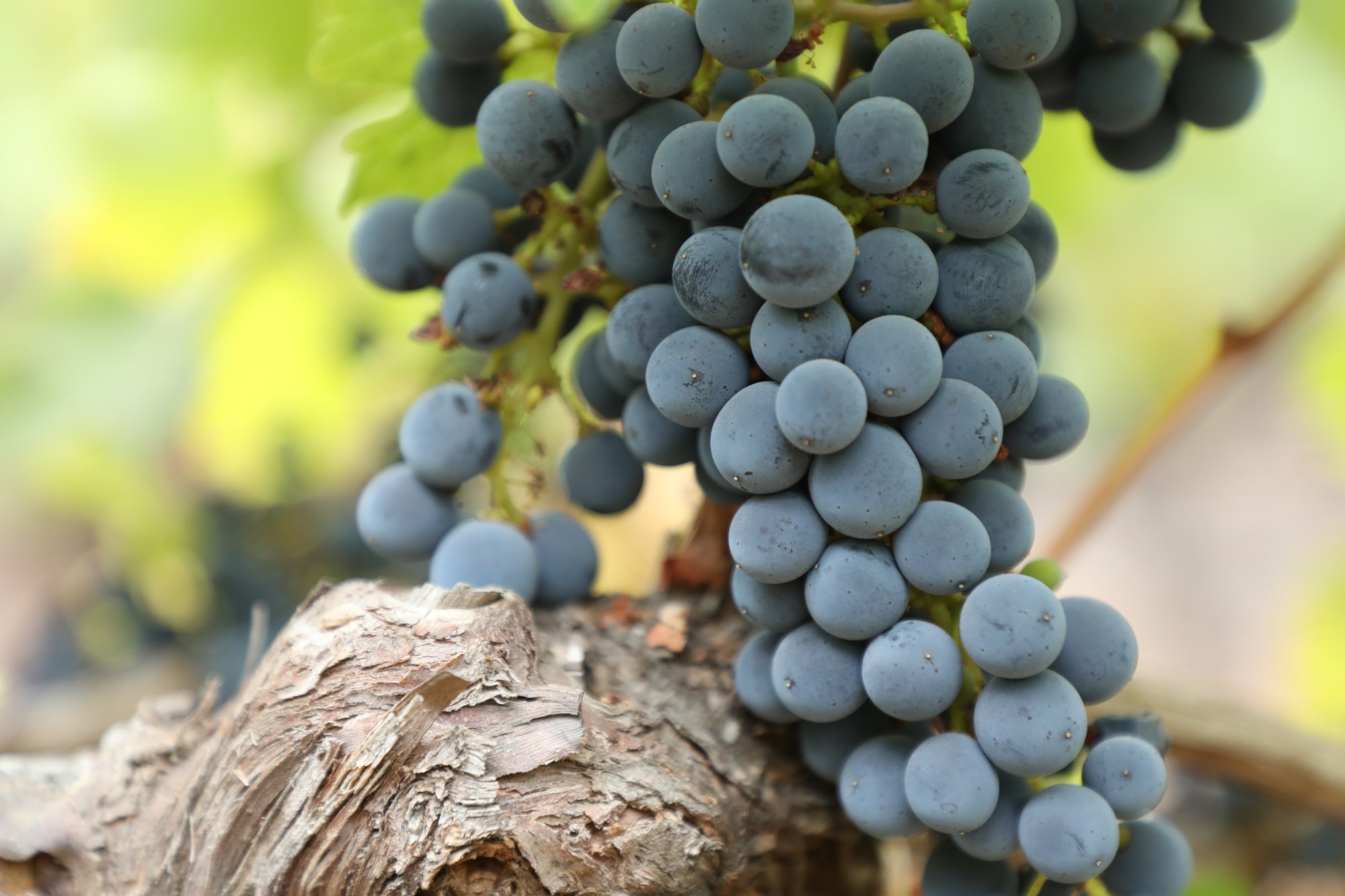
The Hayne Vineyard is situated in one of Napa Valley’s most historically significant vineyard neighborhoods. Nearby are Beckstoffer’s Dr. Crane Vineyard and Bourn Vineyard, as well as the Old Crane Vineyard, farmed by Crane Assembly and recognized as one of Napa Valley’s two oldest verified vineyards still in production. The vines at Hayne Vineyard are dry-farmed, with the exception of young vines, which are hand-watered until they are fully established, and the site has been stewarded by five generations of the Bourn family’s descendants. The vineyard is listed with the Historic Vineyard Society for its old-vine Zinfandel, originally planted in 1905. This organization works to promote and preserve historically important vineyards planted prior to 1960. Ampleur has access to the same vineyard rows each year for its Cabernet Sauvignon, ensuring consistency and a strong sense of place.
In 2025, Ampleur will produce their first Cabernet Sauvignon from Oakville.
—
For more information, to purchase wine, to schedule a tasting or to join their mailing list, visit: www.ampleurcellars.com
Leave a Reply